
What is Industry 5.0?
Industry 5.0 is a relatively new concept and requires a real shift in thinking for businesses to consider their role and contribution to society, beyond efficiency and productivity and profit. The well-being of the worker and the customer and the environment moves to the centre of the production process. “At its heart, Industry 5.0 reflects a shift from a focus on economic value to a focus on societal value, and a shift in focus from welfare to wellbeing’ (Kraaijenbrink 2022 Forbes).
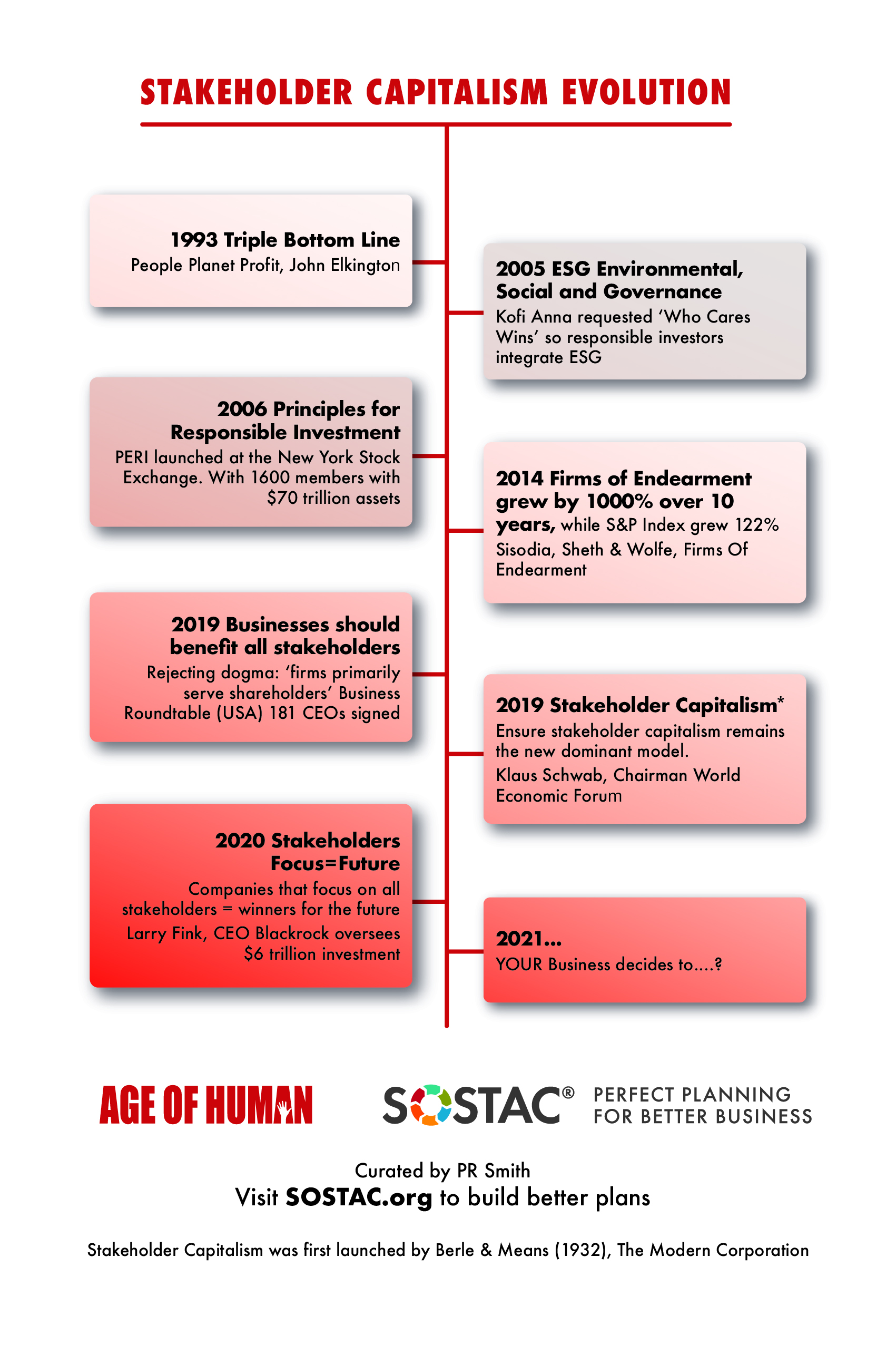
Industry 5.0 shifts the focus away from the seemingly now defunct, shareholder model to the stakeholder model*. Stakeholders include everyone affected by a business e.g. customers, staff, suppliers eco-system, community/environment, governments/regulators and of course, investors/shareholders. As millions in developed countries prepare to trade-off food for warmth, it seems that pure capitalism – driven by shareholder value/ model is only delivering for a small % of the population. Long before the Russian war (and the fuel crisis) the Financial Times posted a one page advertisement declaring ‘Capitalism – time for a reset’. Today, Industry 5.0 highlights this ‘Capitalism re-set’ and the new role of industry with society.
Enter Stakeholder Marketing where all the stakeholders are considered (and not just shareholders). Note this concept was created in 1936, but perhaps now its time has come.
Enter Industry 5.0 – fully supported by the EU Commission in the ‘transition to a sustainable, human-centric and resilient European industry. In order to remain the engine of prosperity, industry must lead the digital and green transitions’ (European Union 2022).
Is Capitalism Broken?
Today, deregulated capitalism seems broken, to me, as oil and gas companies profiteer, push prices beyond the reach of millions of customers – who must now choose between food or heat as poverty reaches new levels in the developed world. Meanwhile, industry-made extreme climate change disasters will kill millions of people in the rest of the world. I can’t believe I just said that. Worse still, the oil and gas industries have made large profits and distributed dividends to their shareholders partly by lobbying, ‘lie-ing’ (BBC iplayer: Big Oil v The World)) manipulating and controlling regulations. How? By carefully sowing seeds of doubt about climate change. Despite their own scientists highlighting climate damage way back in the 1980s (BBC iplayer: Big Oil v The World). This campaign has delayed climate action by at least 30 years and caused damage that may well be now irreparable. Deregulated and heavy lobbying has allowed private companies to, in my opinion, influence and ultimately control, government law-making processes regarding the environment. Result: We now see poverty spinning out of control, across the world, largely because of
- climate change disasters (floods, droughts and fires wiping out food supplies, farms, fields, homes, roads, bridges, lack of clean water and lack of water).
- profiteering by oil and gas companies – pushing energy costs beyond the reach of millions in the developed world – many will die this winter of 2022.
Many other sectors have, it appears, put profits before people. Witness social media giants and tech companies aware of the potential damage their products/services can do, particularly to young people (1 in 4 suffering from anxiety in the USA – NB not solely because of social media). Tobacco companies and perhaps alcohol and energy drinks companies need to be transparent about any potential damage from their products.
Is Industry 5.0 the same as Stakeholder Capitalism?
Industry 5.0 is not a totally new concept. Neither is Stakeholder Capitalism which first emerged in 1932; nor the emergence of Corporate Social Responsibility (CRS but much of this dates back to the Quakers business values), the percent club (1980s), John Elkington’s Triple Bottom Line (People, Planet, Profit in 1993) and ESG (Environmental, Social and Governance in 2005), SDGs (Sustainable Development Goals) to ethical investors influencing ethical behaviour in business. What is new, is the prioritisation of ‘people and planet’ instead of ‘profits and growth’. This is at the heart of Industry 5.0 – a shift from a focus on economic value to societal value and a shift from welfare to wellbeing. This is new.
According to the European Union, Industry 5.0 “provides a vision of industry that aims beyond efficiency and productivity as the sole goals, and reinforces the role and the contribution of industry to society” (European Union 2022). “It places the wellbeing of the worker at the centre of the production process and uses new technologies to provide prosperity beyond jobs and growth while respecting the production limits of the planet.” (European Union 2022)
‘But putting people and planet rather than profits and growth center-stage in the very definition of industry is new. Never before have we seen ‘such radical emphasis on repurposing the core objectives of industry’ (Kraaijenbrink 2022).
3 Pillars of Industry 5.0
- Sustainable (consider all waste and potential by-products so that nothing harmful is dumped back into any stakeholders – witness the circular economy)
- Human-centric (not just customer-centric, but very much staff-well-being / staff-centric also)
- Resilient (to disasters, pandemics, floods, tech attacks, war, hyper-competition and more, plus embrace technology for good)
All three of these will impact strategy significantly. ‘These 3 pillars provide companies with a vision of what true progress will mean over the next years.’ (Kraaijenbrink 2022 linkedin).
‘Strategy’s primary focus will no longer be on growth, profit, and efficiency, but on creating organizations that are “anti-fragile,” meaning that they are able to anticipate, react and learn timely and systematically from any crisis and thereby ensure stable and sustainable performance.’ (Kraaijenbrink Forbes 2022).
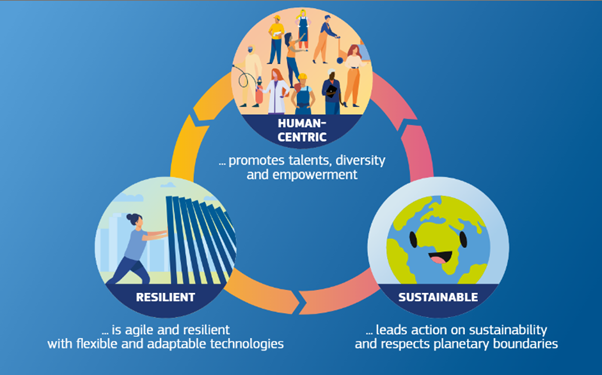
The 3 Pillars of Industry 5.0 (reproduced by courtesy of the Publications Office of the European Union
Where did Industry 5.0 come from?
in 2017, Japan shared its vision of a concept called Society 5.0 at the CeBIT fair in Germany. The EU now seems to have picked it up and is positioning Industry 5.0 high on its agenda.
Industry 1.0 – Steam Engine
Industry 2.0 – Electricity
Industry 3.0 – Internet
Industry 4.0 – 4th Industrial Revolution courtesy of tech developments including automation, robotization, big data (analytics), AI (including Machine Learning), Smart Systems, Connected value chains, IoT, virtualisation and more.
4.0 is the trend that many companies are currently grappling with and trying to incorporate into their strategies.
Industry 5.0 – The EU sees Industry 5.0 as a complement to Industry 4.0 and has put Industry 5.0 high on its agenda.
Is This Industry 5.0?
The Restaurant of Mistaken Orders
Or is it just the milk of human kindness at its contagious best? I asked the creator of the video, Neal Ford. And he told me that he had not gone all the way to thinking it was Industry 5.0 but perhaps just the ‘celebration of the inherent grace humans can give one another if they are given a chance’.
What do you think?
If you liked this you might also enjoy some of my other posts:
Will ChatGPT + ChatBots + Avatars Make Us Immortal?
Chinese GirlBot With 465m Boyfriends
Artificial Influencers Use My Magic Marketing Formula (IRD)
Join my 30 minute Friday chat about AI, Innovation and Ethics in Marketing and Business.
1pm (Dublin/London time) on my Linkedin Profile (scroll down to Activity and then select ‘Events’) .
I also issue a 60 Second Summary of all previous chats here.
If you would like me to send you any of my future posts by email – please enter your email address in the ‘Subcribe and Get Cutting-Edge Alerts’ section (top right corner).
Perhaps also connect with me on Twitter Linkedin Instagram Youtube .
Thanks for the brilliant informative article. The infograph on the evolution on stakeholder capitalism is excellent.
Industry 5.0 is a relatively novel term at moment and as a consultant and academic practitioner, I just want to raise the issue that there is so much terminology being branded around that in some cases, may sound contradictory.
Jeremy Rifkin (2011) in his book, The Third Industrial Revolution; How Lateral Power is Transforming Energy, the Economy, and the World; Palgrave MacMillan has a slightly different framework of the fourth industrial revolution, as he groups the current revolution pertaining to Energy, Communications and Logistics, with renewable energy, the internet (new platforms) and automotive vehicles, as legacies of the Third Industrial Revolution.
The business landscape is clearly changing in a dynamic and dimensional way, as addressed by Michael A. Cusumano et al (2019), The Business of Platforms: Strategy in the Age of Digital Competition, Innovation, and Power, Harper Business. Today, as our lives are more and more technologically driven, we need to understand the digital business landscape according to platforms and how this integrates with offline activities.
A key point that should be recognised is what entity or body of entities have the authority to legitimise these terms, whether it is key business sectors in industry, government, supranational organisations or academia. This in my opinion is where focus should be emphasised.
I agree entirely Ze. Ideally, an auditing process is required to confirm that companies are behaving in an ethical manner and meeting the standards set by Industry 5.0.
An even simpler approach might be to ask all Chartered Accountants and other accountants to confirm whether the many ethical claims in annual reports are actually being measured and delivered.