

Thank you for reading this. If you would like alerts about my future posts please enter your email address in the ‘Subscribe to Marketing Insights’ in the right-hand column.
Perhaps also connect with me on Twitter Linkedin Instagram Youtube or in our weekly chat in the SOSTAC® Plans Club in the Clubhouse App on Fridays at 1pm.
—
You simply have to see the world through your customers eyes. Customer empathy is a great skill. Not just for tactical marketers but for CEOs searching restlessly for competitive advantage. Urbany & Davis (2007) Competitive Advantage ‘The 3 Circle Model’ is simply brilliant. It can be explained in 3 minutes in the this video or read the notes below.
So here’s the very simple yet enlightening Urbany and Davis 3 circle model. Consider the 3 core concepts of Company, Customers and Competition. This is the Customer Circle
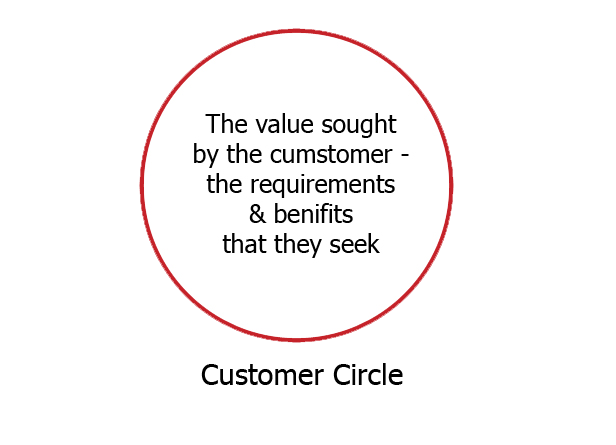
It represents the value sought by the customer – the requirements and benefits that they seek. These requirements and benefits may include deeper values. Essentially the Customer Circle represents what the customer wants or what value the customer is seeking.
The second circle is your Company Circle.
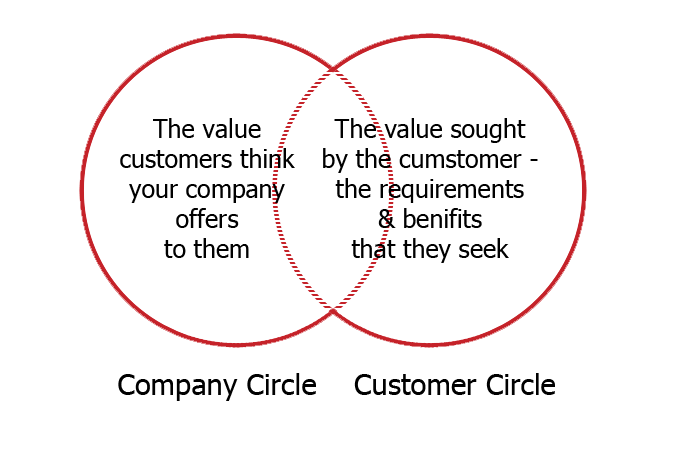
It represents the value customers perceive, or think, you offer to them. This is the way they see it. You have to understand this. The area in the middle within the broken lines (i.e. the overlapping area in the middle) and this is Positive Value. This is the value you/your brand is perceived to deliver to satisfy customer needs. The area on the left is ‘Non-Value’, which Urbany and Davis describe as ‘the product or service you produce that the customer either doesn’t care about, or perhaps, doesn’t know about.’ The area on the right is called ‘Unmet Need’. Urbany and Davis describe these as ‘customer needs that are not satisfied by your products and services and hence they offer a possible future growth opportunity.’
The third circle (below the other two circles) is called the Competitor Circle.
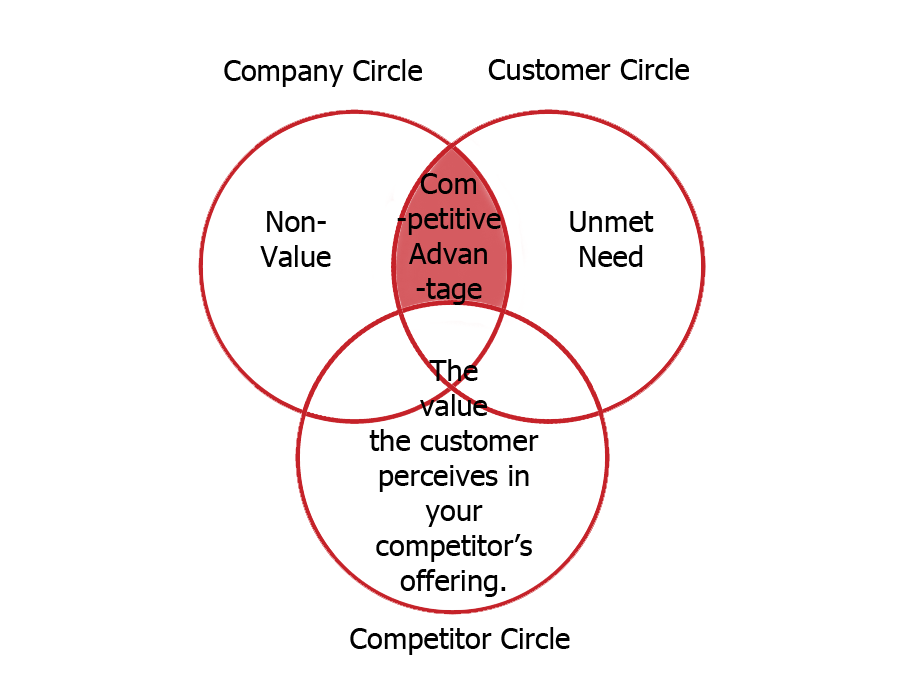
The competitor circle is the piece of the jig saw. It soon opens up a whole new way of thinking…… The competitor circle represents what value does the customer perceive in your competitor’s offering. It’s a Venn diagram. The overlapping shaded area at the top is ‘the pure definition of competitive advantage’. As Urbany and Davis say, ‘this is the value that you create that matters to customers, but, that is different to competition. This is why people choose us.’ This is part of your Strengths & Weakness Analysis which is part of the Situation Analysis is the first part of your marketing plan (using SOSTAC ® Plan)
So the next big question for you is ‘What’s your competitive advantage?’ This excellent question forces you to begin the process of defining your distinctive competitive advantage. Try asking six different members of your team, you might just get six different answers! You’ve got more work to do with your internal communications…….!
The above is extracted from PR Smith SOSTAC® Guide To Your Perfect Digital Marketing Plan (2015) and Professor Urbani’s Youtube video (see above).
Footnote:
2/3 Companies Think They Deeply Know Their Customers But Only 1/3 Of Customers Agree

A recent survey by Pegasystems to see how well businesses in service-centric industries like banking and telco believe they serve their customers compared to what customers are actually experiencing revealed that 66 percent of companies think they deeply know their customers, but only 34 percent of consumers agree with them (Tas 2015). So perhaps your customers do not see your products’ competitive advantage the way, you think, they should see it! Your competitive advantage may actually be a lot more than that which customers perceive. But it is what customers think, & not reality, that actually creates competitive advantage in the mind of your customers. Urbani captures this brilliantly.
–end—
Regarding Competitive Advantage, How Integrated Content Marketing Creates Competitive Advantage shows you how to use marketing content to create competitive advantage.

Hi Paul
So simple but so useful. Point A is key – and needs to be clearly linked to brand positioning as suggested helpfully by Keller’s PODs (Points of Difference) – middle circle also important as POPs (Points of Parity).
Debbie
Thanks Debbie. Nice overlay of POP and POD.
First of all thanks for sharing this article.This is really great article.I completely agree with you that customer empathy is the most important which lead to greater success personally as well as professionally.
Thanks Sarah. It’s so simple really. Not sure why we don’t all do it all of the time.
Yes Sarah – empathy is a skill that many don’t have. Nurture it. In fact I just posted a really nice empathy image an quote from 100 years ago still valid today – see http://www.facebook.com/PRSmithMarketing – today and also 2 Oct post – I think you’ll like them!
Perfectly written!
I’ll immediately seize your rss feed as I can’t to find your
email subscription link or e-newsletter service.
Do you’ve any? Kindly permit me realize in order that I may just subscribe.
Yes the site is temporarily disabled and being fixed. You will be able to subscribe to updates once again, very soon. Apologies for any inconvenience. Thanks for the alert.
Many thanks. When you have selected a specific blog post, open it. Then see the right hand column where it says: ‘Subscribe to Marketing Insights
Enter your email address to receive new posts by email.’ Regards, Paul