
Thank you for reading this. If you would like alerts about my future posts please enter your email address in the ‘Subscribe to Marketing Insights’ in the right-hand column.
Perhaps also connect with me on Twitter Linkedin Instagram Youtube or in our weekly chat in the SOSTAC® Plans Club in the Clubhouse App on Fridays at 1pm.
—
Continuing from How Trump Won – part 1 – SOSTAC ® Analysis, where we looked at the first three stages of the plan: Situation Analysis (where was Trump?); Objectives (where did he want to go?) & Strategy (how was he going to get there?), now let’s explore Tactics (the details of strategy); Action (how to ensure excellent execution) and Control (how do we know we are getting there?). In particular, we’ll explore how he used, what I call, the Magic Marketing Formula to win.
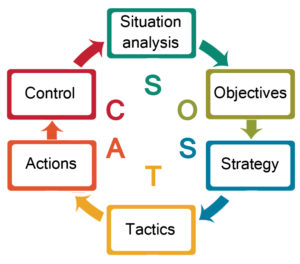
PR Smith’s SOSTAC® Planning Framework www.SOSTAC.org
Tactics
Tactics include the marketing mix and this includes the communications mix. So whether it is a facebook ad, a social media post or tweet, a conference speech or any tactical tool, the key (apart from targeting) is to ensure the right message is shared (or ‘reflected to the audience’). This is, what I call, the Magic Marketing Formula.
The Magic Marketing Formula – IRD
The Magic Marketing Formula: IRD
Here it is: Identify (needs); Reflect (those needs with solutions or sometimes just slogans) back to your audience; Deliver (a reasonable product or service).
Make America Great Again = Magic Marketing Formula
Let’s start with the general message (the slogan that was used everywhere). This was shared (or reflected back to all audiences). We will look at other, more specific messages, including ‘dark posts’, sent exclusively to very specific audiences (that others could not see easily as they targeted discrete audiences after they had profiled the personality of every adult in the USA – 220 million profiles). More on this in Part 3. But, first, let’s look at Trump’s slogan.
“Trump’s ‘Make America Great Again’ was designed to make white working-class men remember when things were better for them or, at least, they thought they could remember.” Stephen Greyser, professor of marketing at Harvard Business School Fottrell (2016).
‘Make America Great Again’ has a certain ‘darkness at the edge of that slogan as there is (also) a darkness at the edge of ‘Take Back Our Country’ (the Brexit Leave Campaign) & yet there’s also a glimmer of a legitimate & important aspiration in both of those slogans. … …. the legitimate aspiration underlying those slogans has to do with a sense of national community’ (Harvard’s Professor Sandel 2017). Trump addressed the people’s anger. Perhaps Clinton assumed the anger was against immigration and trade, and at the heart of that, is jobs. ‘But it’s also about even bigger things., about the loss of community, disempowerment, & social esteem (a sense that the work that ordinary people do is no longer honoured & recognised (& rewarded).’ Sandel (2017). So the need for community (national community), amongst other needs is reflected back through the consistent use of the slogan. Therefore appealing to hidden needs, needs that perhaps, many voters weren’t even conscious of during their voting.
Professor Michael Sandel, speaking at Davos 2017
Professor Sandel continues: ‘The language of patriotism has been appropriated by the right for the most part. There’s no reason why centre-left parties can’t reclaim and articulate their own conception of national purpose, national community and shared identity & patriotism. What the elite missed was the sources of the anger & resentment that has lead to the populist upheavals in the US & Britain & many other parts of the world.
Pavlovian Conditioning?
Although Trump is part of a different establishment (business establishment) swing voters seemed to accept his carefully controlled positioning as a non-establishment politician (see part 1: Positioning) . Perhaps a Pavlovian conditioning – repeating the same message again and again and after a while his audience believed this, despite seeing Trump flying around the country in his “Trump” branded 757 plane. Perhaps because by doing so he showcased an aspirational lifestyle that appealed to white, working-class Americans (NB the magic marketing formula: identify needs/aspirations – reflect them back, ironically, via your own mobile media/your own private jet).

Is it possible that Donald Trump conditioned voters just like Russian physiologist, Dr. Ivan Pavlov, conditioned dogs back in 1902? www.PRSmith.org/SOSTAC
Tactics: Proposition: ‘Change’
The promise of ‘change’ worked for Obama previously & this time it worked for Trump too. Interestingly, both Trump and Obama (in previous Obama campaigns) identified that many people still want change. Obama promised it in a positive light ‘whilst Trump used anger to get it across’ (Kanski 2016). However, this time, Trump went after the disenchanted relentlessly and rammed home his message of ‘angry change’.
“In the end it was a clear-cut message: If you’re happy with the status quo, vote for her; if you want change, vote for me,” said Dan Scandling, senior director of public affairs at APCO Worldwide. “That was what resonated.”
“She (Clinton) never effectively communicated how she was going to make people’s lives better beyond hanging her hat on the last eight years,” says Aaron Gordon, partner at Schwartz Media. (Kanski 2016).
Clinton’s more rational (and longer) economic and social arguments might have missed the attention span of those swing voters, as did the ‘Remain’ campaign in the UK’s now notorious Brexit referendum. Lord Heseltine (former UK Deputy Prime Minister under John Major and Secretary of State under Margaret Thatcher ) summed up short attention spans, lack of facts and policies, when referring to the UK’s Brexit, he pointed the finger at one of its ‘Leave Campaign’ leaders who has since become the UK’s foreign minister, Boris Johnson, and said:
“How convenient to substitute a slogan in place of arguments you have not got.” (Rogers 2016)
As our attention spans have shrunk from 42 seconds in 1960 (see How Trump Won part 1) to 5 seconds in 2008 and now 4 seconds, the words of John C. Maxwell (‘leadership’ author) resonate more profoundly:
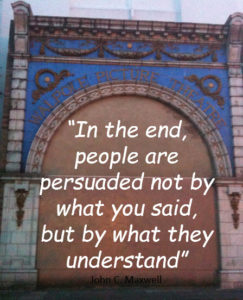
John C Maxwell (leadership author)
Proposing What Audiences LikeTo Hear (IRD)
‘What that translates into is a constant iterative process whereby he (Trump) experiments with pushing the conversation this way or that, and he sees how the crowd responds. If they like it, he goes there. If they don’t respond, he never goes there again, because he doesn’t want to be boring. If they respond by getting agitated, that’s a lot better than being bored. That’s how he learns….. In that sense, he’s perfectly objective, as in morally neutral. He just follows the numbers. He could be replaced by a robot that acts on a machine learning algorithm’ (O’Neil 2016).
Through data analysis (big data) Trump was able to send different messages to different groups of voters with different needs. ‘Cutting immigration’ or “draining the swamp” of corrupt or incompetent politicians and bureaucrats – messages were targeted only at those that connected with these messages. (I’m going to have to do a Part 3 to explain how this worked).
‘Once up and running at the end of the summer, it was soon sending out tailored messages to 100,000 targeted voters every day’ (Marr 2017).
See the BBC video in Part 1 that explains exactly how Cambridge Analytica analysed the adult voting population of America (without them knowing their data was being used in this way) and subsequently targeting precise ads to each personality type telling them just what they wanted to hear.
Proposition, Message Credibility & Messages
Trump reached many disenchanted blue collar male voters by reflecting his messages in their language e.g. by ‘talking about the world and globalism in terms of winners and losers,’ Eric Bovim (Kanski 2016). Not everyone can understand social economics, but everyone understands the concept of winners and losers. Short. Simple. And not weighed down by actual facts or policies.
Having said that, if a significant proportion of the voting population do not want to hear long-winded arguments, then Trump just applied the Magic Marketing Formula (IRD) again and again, by keeping it short, tapping into fears and emotions, reflecting keywords that connect, but avoiding detail at all costs.
Trump Is A ‘Meaningfully Different Brand’
‘Meaningfully different brands’ are much more likely to be selected, to command greater premiums and to grow in the future,” says Christopher Murphy, chief client officer at brand analysts, Millward Brown North America.
Q1 Does the candidate meaningfully connect – either functionally or emotionally?
Q2 Is the candidate seen as different or capable of driving positive change?”
Trump, Murphy concluded, did both (Fottrell 2016).
Tactical Tool – twitter
Trump’s preferred vehicle to spread his message was largely his Twitter feed. He built his momentum on Twitter, spreading the #MakeAmericaGreatAgain or #MAGA hashtag widely. 12 million followers (9 Nov – now 16.4m)
Clinton’s Twitter feed (11.4m) felt more traditional and political (Kanski 2016). Clinton’s slogan ‘Stronger Together’ did not generate nearly as much traction. It is possible to predict which tweets/messages will get the most retweets (see IBM twitter analysis). Though I could have forecasted ‘Stronger Together’ was limp and wouldn’t gain much traction.

Tactical Tool – Targeting Facebook Ads: 1,000% Increase in Sales
Jared Kushner (Trump’s son in law) who set up the stage 2 Strategy (see Part 1), database decision making and highly targeted facebook ads (& other cable TV targeted ads), also quickly learned how to continually refine the targeting of facebook ads. See 200 variables available to target specific messages. In fact, he quickly increased the sales of Trump merchandising (e.g. baseball caps with ‘Make America Great Again’) from $8,000 to $80,000 per day – ‘simply by refining the target demographic’ (Marr 2017).
ACTION
Build A Campaign Team
Soon, Jared Kushner, was assembling a speech and policy team, handling Trump’s schedule and managing the finances.
Build A Data Centre
As mentioned in Part 1, within three weeks, in a nondescript building outside San Antonio, Kushner built what would become a 100-person data hub designed to unify:
- fundraising
- messaging
- targeting
They also tapped into the ‘Republican National Committee’s data machine, and it hired targeting partners like Cambridge Analytica to map voter universes and identify which parts of the Trump platform mattered most: trade, immigration or change’ (Bertoni 2016) . Forbes reported: ‘Tools like Deep Root drove the scaled-back TV ad spending by identifying shows popular with specific voter blocks in specific regions–say, NCIS for anti-ObamaCare voters or The Walking Dead for people worried about immigration.
Kushner built a custom geo-location tool that plotted the location density of about 20 voter types over a live Google Maps interface.’

Kushner built a custom geo-location tool that plotted the location density of about 20 voter types over a live Google Maps interface
Very quickly data determined decisions, so just like Teddy Goff and previous Obama campaigns, data dictated almost every campaign decision including:
- travel
- fundraising
- advertising
- rally locations
- topics of the speeches
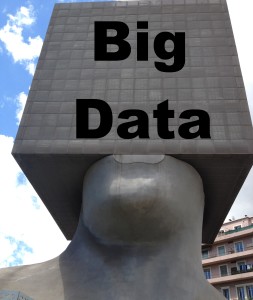
Big Data is everywhere
Build A Disruptive Start-Up Culture
Kushner was unschooled in traditional campaigning, he was, therefore, able to look at the business of politics in the same way that so many entrepreneurs analyse and attack other bloated industries.
Learn Rapidly
Kushner knew what he needed to know. He knew what he needed to learn and learn it quickly. So in Kushner’s own words: “I called some of my friends from Silicon Valley, some of the best digital marketers in the world, and asked how you scale this stuff? They gave me their subcontractors. I had them give me a tutorial on how to use Facebook micro-targeting.” Synched with Trump’s blunt, simple messaging, this would go on to work very well.
Constant Beta Testing
Constant beta Testing = Constant Learning = Constant Improvement. Trump was selling $8,000 worth of hats and other items per day. Bit by bit Kushner learned how to improve this with better targeting via facebook ads. Once they found something worked – they scaled it up. Result: sales grew from £8k to $80k per day thus:
- generating revenue
- expanding the number of human billboards
Constant Beta Testing requires a cultural shift which, in turn, requires constant monitoring and control (see ‘Control’ section).
No Fear Of Failure
The entrepreneurial spirit / disruptive start-up culture ensured that there was no fear of failure just a hunger for fast improvement & scalability. “We weren’t afraid to make changes. We weren’t afraid to fail. We tried to do things very cheaply, very quickly. And if it wasn’t working, we would kill it quickly,” Kushner says. “It meant making quick decisions, fixing things that were broken and scaling things that worked.” (Bertoni 2016).
“We weren’t afraid to fail.” Kushner
Scale Up What Works – Tailor Targeted Ads
Scale What Works & Stop What Doesn’t – quickly. Ineffective ads were killed in minutes, while successful ones were scaled up. Trump’s team ended up sending more than 100,000 uniquely tweaked ads to targeted voters each day.
Use Machine Learning
Machine learning helped to boost their fundraising efforts. Kushner installed digital marketing companies on a trading floor to make them compete for business. If anyone has more information on how Donald Trump’s team used machine learning, please do let me know, as I will be doing a Part 3 about Big Data helped Trump to win.
Control
Sales Revenues & Donations
The Trump team monitored revenues every day. The campaign raised more than $250 million in four months–mostly from small donors. They kept monitoring and learning what worked best and then scaled up.

Constant Real-Time Analysis
Constant up-to-the-minute voter data, provided both ample cash and the insight on where to spend it. ‘When the campaign registered the fact that momentum in Michigan and Pennsylvania was turning Trump’s way, Kushner unleashed tailored TV ads, last-minute rallies and thousands of volunteers to knock on doors and make phone calls’ (Bertoni). See Part 3 (‘How Big Data helped Trump’.
Ask Great Questions
Kushner asked this seemingly basic question which really focussed the campaign team’s minds: “How can we get Trump’s message to that consumer for the least amount of cost?” FEC filings through mid-October indicate the Trump campaign spent roughly half as much as the Clinton campaign did (Bertoni 2016).
Monitor Bangs For Your Buck
Kushner even spent $160,000 to promote a series of low-tech Trump policy videos which generated more than 74 million views which equated $2 CPT (Cost Per Thousand people reached). In addition to getting more cost effective, Kushner was learning which video messages worked best.
Constant Beta Testing
“We played Moneyball, asking ourselves which states will get the best ROI for the electoral vote,… Kushner
Monitor Twitter Streams
Using 3,000 tweets from Trump and 3,000 from Clinton, here is Trump’s most frequently used words visualised in a word-cloud:
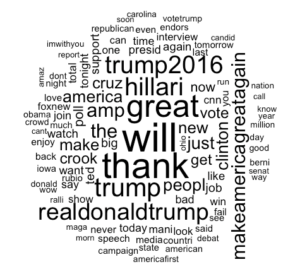
Trump’s Word Cloud identifying his most frequently used words
Here is Clinton’s most frequently used words:
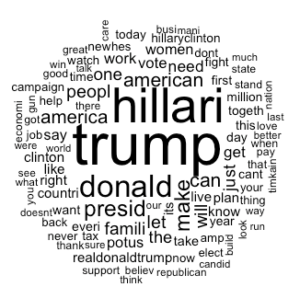
Clinton’s Word Cloud identifying her most popular words
Trump’s most common words used in his tweets were positive (i.e., great, will, thank, as well as the hashtag #MAKEAMERICAGREATAGAIN). These all have positive meanings. Clinton’s most frequently used word on Twitter was trump (NB lower case disrespect!). What does this tell you?
Incidentally, it is possible to predict how successful* a tweet will be (or predict the performance of a selection of tweets and thus select the best one to send). * One success criteria is the number of retweets forecasted (within a certain level of confidence) Cortana 2016. If you enjoy data mining, you might enjoy this from Microsoft’s machine learning people. Everything generates feedback and learning, which is fed back into the system to update the situation analysis, refine objectives, inform strategy and tactics as you can see in the diagram below. part 3 will explore how door-door canvassers fed back data regarding which message worked best for each household.
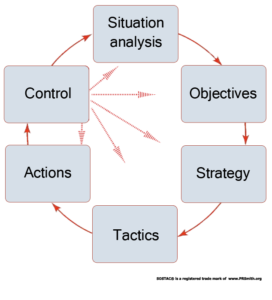
Control monitors and collects feedback which is constantly used to update all other sections of a SOSTAC® plan.
In the end….
crystal clear positioning and targeting driven by clever use of data layered on top of the Magic Marketing Formula combined with a ‘disruptive start-up’ attitude’ always ready to learn and constantly improve every hour – delivered Trump, the outsider, the most unexpected of wins (despite winning less than 2 million votes than Clinton). As Forbe’s Bertoni reports:
‘If the campaign’s overarching sentiment was fear and anger, the deciding factor at the end was data and entrepreneurship.’
‘Trump looked at the US and correctly saw an anxious populace that was ripe for facile answers, scapegoats and a narrative of unjust victimisation. So he pounced.’ Frank Bruni, New York Times, 14 Dec 2018
—
You might also enjoy How Obama Became America’s First Black President
You might not enjoy, but perhaps need to read: The Dark Arts Of Marketing – Breaking Down Society to Create a New Culture – Using Data & IRD
How SOSTAC® Works – a 4 minute video by PR Smith
How SOSTAC® Works – a 4 minute video by PR Smith
Become a SOSTAC® Certified Planner visit www.SOSTAC.org
The SOSTAC® Guide to your Perfect Digital Marketing Plan
Sources:
Bertoni, S. (2016) How Jared Kushner Won Trump The White House , Forbes December 20
Cortana Intelligence & Machine Learning (2016) Data Mining the 2016 Presidential Campaign Finance Data, Cortana Intelligence and Machine Learning Blog, 10 Oct
Economist (2016) The post-truth world: Yes, I’d lie to you, 10 Sep
Flood, A. (2016) ‘Post-truth’ named word of the year by Oxford Dictionaries, The Guardian, 15 Nov.
Fottrell (2016) How TV reality star Donald Trump won the election with his ‘disruptive’ brand, MarketWatch.com 11 Nov.
Grassegger, H. & Krogerus, M. (2017), The Data That Turned the World Upside Down, Motherboard, 28 Jan
IBM (2016) Trump and Clinton may have used some Machine Learning, DataScience.ibm.com , 21 Dec http://datascience.ibm.com/blog/election-2016-data-analysis/
Kanski, A. (2016) Change and authenticity: The messages that won over American voters, PR Week 09 Nov.
Marr, B. (2017) Why Big Data Wasn’t Trump’s Achilles Heel After All, Forbes 9 Feb
O’Neil, C. (2016) Donald Trump is like a biased machine learning algorithm, Mathbabe.org 11 Aug
Rogers, D. (2016) The Politics of Fear, in an interview with Lord Heseltein, PR Week, April 2016.
Sandel, M. (2017) ‘ Why The Democrats are so out of touch with the People‘, World Economic Forum, Davos 2017 – (a very interesting video).
I hope these articles continue, so insightful! Clinton’s team could have certainly done better in terms of research and creating her brand. ‘Stronger Together’ sounds rubbish in comparison to ‘Make America Great Again’
Agree totally Donna – see Harvard’s Professor Sandel’s discussion re these slogans. I highlighted his video at the very end in the sources. It’s intriguing.
Donna, thanks for the heads up on this article. Paul, interesting article, well done.
Fascinating reading. Shows how Sostac can be used in so many situations. Post analysis, being one of them. The links below are very interesting too. Thanks for posting.
Excellent stuff. This shows to what extent politics and commerce have become enmeshed.
I am so happy to see the SOSTAC can be used to analyse hard issues such as political and economic dilemmas. I really wonder what SOSTAC will bring to my career. Beneficial article for all.
Thanks Mucahit Mihci, SOSTAC® can be used for marketing plans, digital marketing plans, campaign plans, business plans, project plans, H&S plans, security plans, even wedding plans! Check out http://www.SOSTAC.org for more info or to become a SOSTAC® Certified Planner.
I am looking forward to reading Topic 3 with more in-depth analysis about micro-segmenting and utilize data to target to different small sub-segments.
Huy Nguyen, you might be interested to watch the shocking video The Dark Arts Of Marketing – Breaking Down Society to Create a New Culture – Using Data & IRD
https://prsmith.org/2018/03/22/the-dark-arts-of-marketing-breaking-down-society-to-create-a-new-culture-using-data-ird/
FACEBOOK SUED BY D.C. OVER CAMBRIDGE ANALYTICA DATA SCANDAL
Published on December 19, 2018.
https://adage.com/article/digital/facebook-sued-d-c-cambridge-analytica-data-scandal/316038/